
If your Facebook ads not generating leads, it can generally be attributed to a combination of at least one of the following issues: poor targeting, creative copy that misses the mark, landing pages that are not performing as expected, tracking issues, wrong campaign goals, or spending too little of your budget that Meta’s algorithm has no opportunity to learn.
In the past months, we’ve said this to many founders and marketers who wondered the same thing. In our experience, Facebook’s Ads Manager can be misleading if tracking or attribution aren’t set up. Instead, it presents a dashboard full of positive numbers while your sales pipeline remains empty. This guide clarifies the situation for you, free of jargon.
Your Targeting Is Too Broad or Too Narrow
This is one of the common causes of Facebook lead generation problems – and it works in both directions. If you go too broad with your targeting, showing ads to people who are less likely to buy, then the Meta engine spends your budget while showing ads to people who would never buy.
If you go too narrow by adding five interests and using a radius of one mile, the delivery gets so poor that the system may struggle to exit the learning phase.
Mistakes in targeting on Facebook Ads happen because of copying the audience of your competitor without making sure that it fits your funnel stage. Cold audiences often work better with broader targeting. On the other hand, the retargeted audience is usually better defined by behaviour than by many interests.
Treating both types of audience equally is the reason why many accounts experience good reach but bad quality of leads. The constraint isn’t about adding more layers. Rather, it is about delivering more efficient Facebook Ads consumer targeting using reliable buyer indications: web traffic, email look-alikes, social interactions and recent engagement. Make use of Meta’s optimisation to reach relevant audiences based on intent signals.
Weak or Mismatched Ad Copy & Creative
An ad may have strong targeting but still underperform in the feed if the opening line does not grab people’s attention. A boring stock image, an unimaginative headline, and an insignificant call to action. Many Facebook ads that fail to convert are caused by creative failures, not just delivery issues.
One example that we have seen over and over again is with B2B and service companies. The ad copy talks about the company (“We are the leading provider of…”) instead of addressing the audience’s pain points. People scrolling through their feeds usually care more about their own concerns than your company claims. They care whether you can help fix whatever is causing them hurdles.
Here are some Facebook ad copy tips –
- Open your copy with the dilemma being faced and not your name. Applying a real number is more effective than using a vague statement.
- You also have to verify that the type of creative you are using and the placement of the ad match. For example, video often frequently delivers improved success in Reels and Stories than a static banner. And, before declaring that a particular audience does not respond well to your ad campaign, make sure to test at least three different ad copies since it is often the ad that fails, not only the target audience.
AI Video Ads and UGC Content Misuse

More and more Facebook ad accounts are underperforming because of a new factor: advertisements made with artificial intelligence technologies and UGC-style videos. This is potentially one of the less-discussed Facebook ad problems, particularly given the increasing number of companies using AI services to reduce production time and costs.
The problem isn’t AI itself; it’s how it’s used. Most AI-generated videos look and sound similar, since they’re built on the same templates, stock voices, and uniform scripts. When an audience member sees dozens of companies using the same style in their ads, the ad blends in rather than standing out. This similarity is usually mistaken for a targeting issue when, in fact, it’s a creative issue.
UGC-style content carries similar risks. UGC works only because it comes across as authentic and unscripted. Unfortunately, advertisers often misuse it, creating content that doesn’t fit the context, doesn’t solve a real problem, or feels outdated.
An even bigger issue, though, is treating creative the same way across all businesses, regardless of their specific needs. A good example is an AI-generated real estate video that doesn’t match the actual property, neighborhood, or property type -it not only looks off but also fails to attract leads, since real estate buyers are highly localised and quick to move on if something feels overpriced or generic. The same holds true for any industry: healthcare ads need a different tone and pacing than SaaS ads, for example.
Before scaling a campaign with AI or user-generated content, run a content evaluation to confirm the material is tailored to the right audience, industry, and geographic location.
Using the Incorrect Ad Type for the Offer
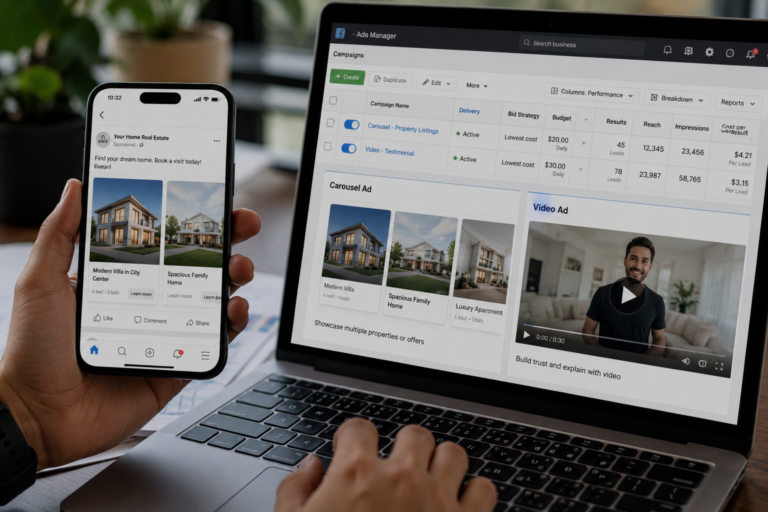
Choosing video or a carousel out of habit – instead of factoring in the offer itself – is an overlooked reason behind underperforming Facebook ads. Some advertisers pick whichever format is fastest to create, without considering which one actually fits the product or service being advertised.
Carousel ads should be used when there are multiple things to showcase together – products, items, offers, etc. This format works well for real estate listings, e-commerce catalogues, and multi-service offers.
Video ads should be used when the goal is to build trust or explain something a static image can’t – showing a process, a testimonial, or a demonstration.
Landing Page Isn’t Optimised for Conversion
It is possible to obtain the click but still lose the lead. There are many possibilities for conversions to be undermined: a slow-loading landing page, long forms consisting of too many fields to fill in, problematic mobile optimisation, and an inconsistency between the title of the ad and the landing page. This is among the most ignored Facebook lead generation issues since it is entirely out of Ads Manager’s area of operation.
This means that the advertising platform can report high CTR, while at the same time any traffic that could be generated by the ad gets lost long before the form is submitted. To improve Facebook ad performance, you should take more parameters into account besides advertising metrics, including page loading, the number of fields in the form and the credibility symbols on the landing page like testimonials or client logos.
Facebook Pixel/Conversion Tracking Errors
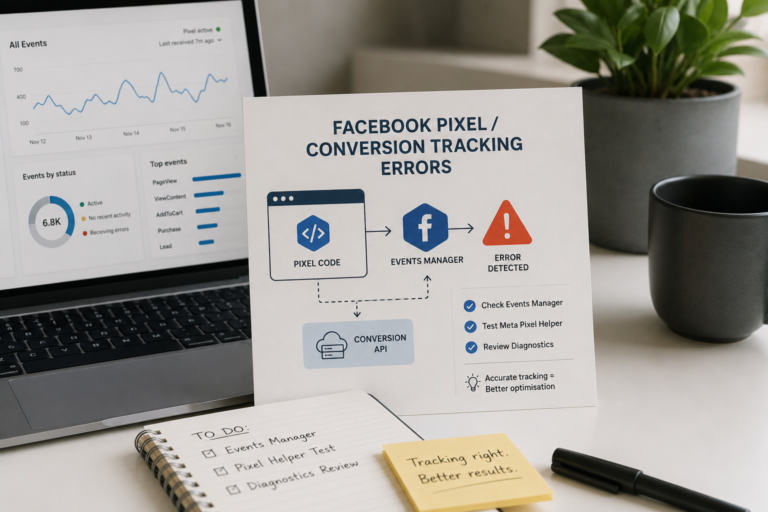
Generally, a malfunctioning pixel installation is one possible factor behind complaints regarding low-quality leads Facebook ads. When the pixel is not receiving information properly, or if the Conversion API is not properly paired with the pixel, optimisation may depend on less complete data. Before switching campaign settings, it is advisable to check Events Manager, test the Meta Pixel Helper and review Diagnostics.
Wrong Campaign Objective Selected
Choosing traffic where leads would be appropriate, or engagement simply because it is cheaper, only yields a collection of vanity metrics. Right from your chosen goal, Meta’s optimisation will proceed. If the goal does not suit the outcome of the business, the ‘Facebook ads not converting’ issue will become even more challenging.
As a rule, for companies providing services or IT businesses that want to increase the number of form fill-ups or demo requests, it is strategic to choose Leads according to the on-platform form or Conversions rooted in well-configured landing pages.
Ad Fatigue & Poor Budget Allocation
If a particular audience is exposed to the same advertisement multiple times, frequency can rise alongside the cost per result, which can lead to fatigue and weaker outcomes.
Lead generation conversion rates may vary by industry, so there is no universal benchmark that applies to all accounts. If a small daily budget is split across six ad sets, each ad set may not get enough volume for Meta to learn effectively. Grouping budgets into fewer, larger ad sets performs better compared to spreading every dollar thinly.
If you are facing any of the above challenges, use the checklist to fix Facebook ad leads.
How to Fix It – Quick Checklist
- Make sure theFacebook pixel setup is done properly, and that the Lead event shows in Events Manager
- Focus on targeting audiences for ad campaigns using real engagement signals such as video interactions
- Refresh creative regularly to avoid fatigue and test multiple versions where possible
- Ensure there are no discrepancies between the message in the ad and promotion on the landing page
- Align objectives in campaigns with real objectives of the business, not only with the lowest cost per result
- Combine budgets in fewer ad sets instead of distributing too thinly over many ad sets
- Examine frequency weekly; in many media cold audiences, a rising frequency can be a warning sign, depending on the audience and speed
- Check your consent and data processing compliance alongside Conversions API setup and local laws
- Evaluate AI-created and user-generated content to confirm that it fits the needs of your industry and target audience, instead of just following a standard template.
- Select the correct format for your advertisement based on the offer.
FAQ'S
When this issue happens, the landing page, pixel, ad creative, targeting, offer or follow-up process may be contributing. First of all, make sure you are not making any Facebook ad targeting mistakes and confirm that the lead event is tracked correctly and that the landing page is actually matching what the ad promises.
Meta generally is more efficient at optimising when a campaign has enough conversion volume, but the exact timeframe and event count depend on the objective and setup.
Conversion rates for lead generation can vary widely by industry, and 4 to 9% may be a rough reference range in some lead-gen cases.
Indeed, it does. As the number of times the audience sees a similar image increases, the engagement quality can decline as ad fatigue increases.
Conclusion
If there’s one thing to remember from here, it’s that improving your performance on Facebook ads means looking at the whole process instead of focusing on Ads Manager only. Once you see the entire situation, everything becomes easier to understand, but it’s often tricky to identify issues when you are preoccupied with reports. Many businesses do not have just one ” issue like Facebook ads audience targeting. Usually, they have several tiny problems that interfere with each other, and solving just one may not be enough to achieve the needed results.
At Go Digital Bro, our performance marketing team performs a full account audit – we check Pixel and Conversions API events in Events Manager, review the last 3-5 relevant ad sets for frequency, CTR and CPM trends to detect creative fatigue, compare your ad copy with your landing page text and map your campaign goal to its current funnel stage.
You will receive a complete overview of the aspects of your campaign that need fixing and why and how they are working. Book a free consultation with us today.